
Kwara Eyes Slice of Nigeria’s Booming $70bn Livestock Market
Kwara State outlines industrial strategies to capitalize on Nigeria's projected $70 billion livestock market, utilizing specialized economic zones to attract private agro-allied investments.
Category: press-release
•May 25, 2026
The Kwara State Government has unveiled an assertive policy layout to anchor itself as a dominant hub in Nigeria’s livestock sector, which market analysts forecast will surge past $70 billion from its baseline of $32 billion.
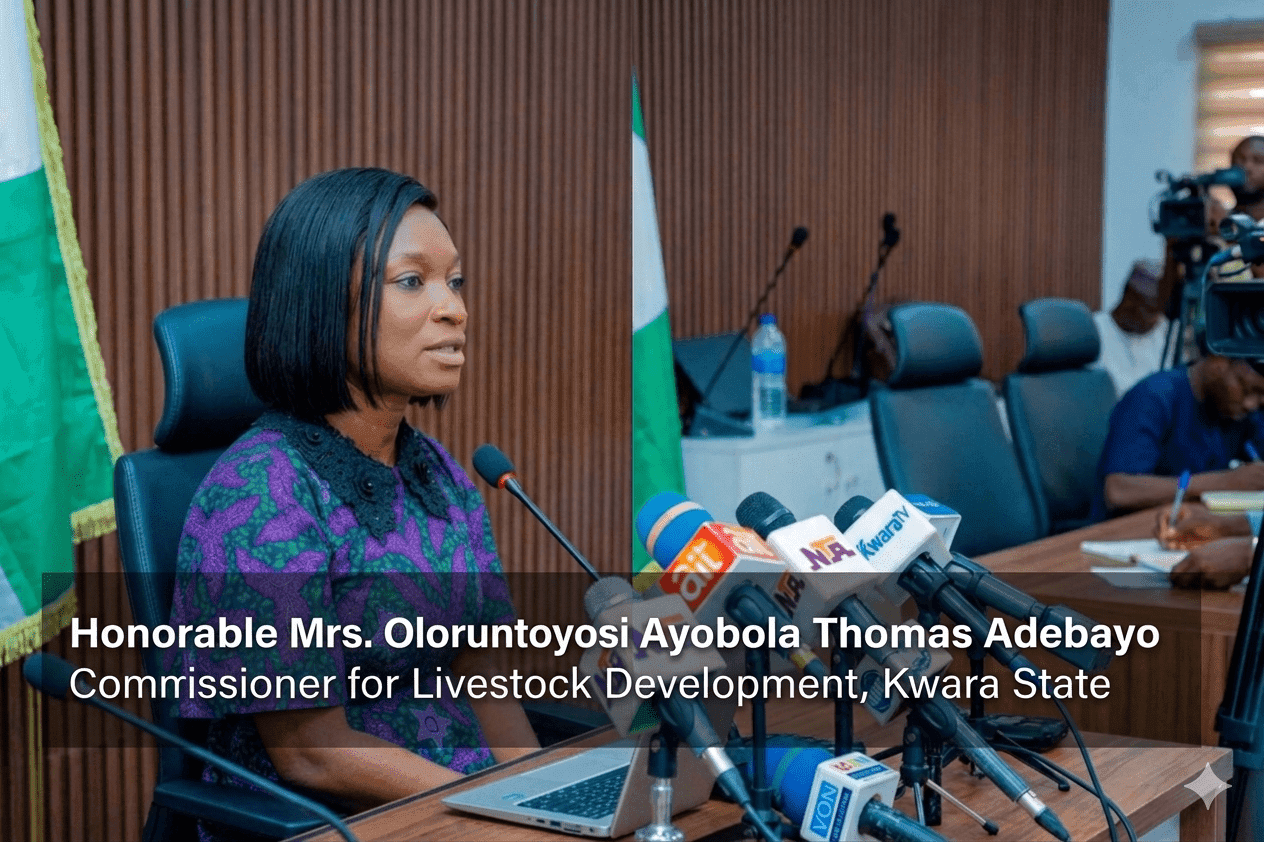
The policy direction was spotlighted by the State Commissioner for Livestock Development, Mrs. Oloruntoyosi Thomas, during her keynote address at the 2026 Press Week of the Correspondents’ Chapel, Nigeria Union of Journalists (NUJ), Kwara State Council.
Deliberating under the theme, “Livestock Development in a Changing Economy: Innovation, Opportunities and the Role of Strategic Communication in National Growth,” Thomas defined animal husbandry as an untapped economic accelerator capable of driving industrialization and sub-national wealth.
## Shifting From Subsistence To Industrial Processing Nodes
Under the leadership of Governor AbdulRahman AbdulRazaq, the state is executing a deliberate transition away from low-yield, smallholder cattle rearing toward a completely commercialized agro-industrial ecosystem. The administration’s roadmap hinges on value-chain integration, import reduction, and structural infrastructure deployment designed to appeal to private equity investors.
To systematically scale these operations, Kwara is coordinating two anchor programs:
1. The Special Agro-Industrial Processing Zone (SAPZ): A dedicated economic enclave built to provide investors with uninterrupted off-grid power, standard transport networks, cold-chain preservation networks, modern abattoirs, and veterinary laboratories.
2. The Livestock Productivity and Resilience Support Project (L-PRES): A state-wide intervention framework providing artificial insemination centers, modern logistical hubs, and specialized residential zones to foster operational ease for agro-processors.
Thomas affirmed that these structural developments are not happenstance but rather represent a calculated methodology to transition the local workforce into sustainable wealth creators.
### Empowering Development Through Analytical Reporting
Earlier in the event, the Chairman of the Correspondents’ Chapel, Biola Azeez, welcomed industry stakeholders and reaffirmed the press corps' focus on development journalism.
Highlighting that the chapel represents an elite reportorial cross-section of both national and global media brands, Azeez noted that professional mass communication remains a core pillar in shaping constructive public discourse and attracting development partners to regional economic reforms.
Share on